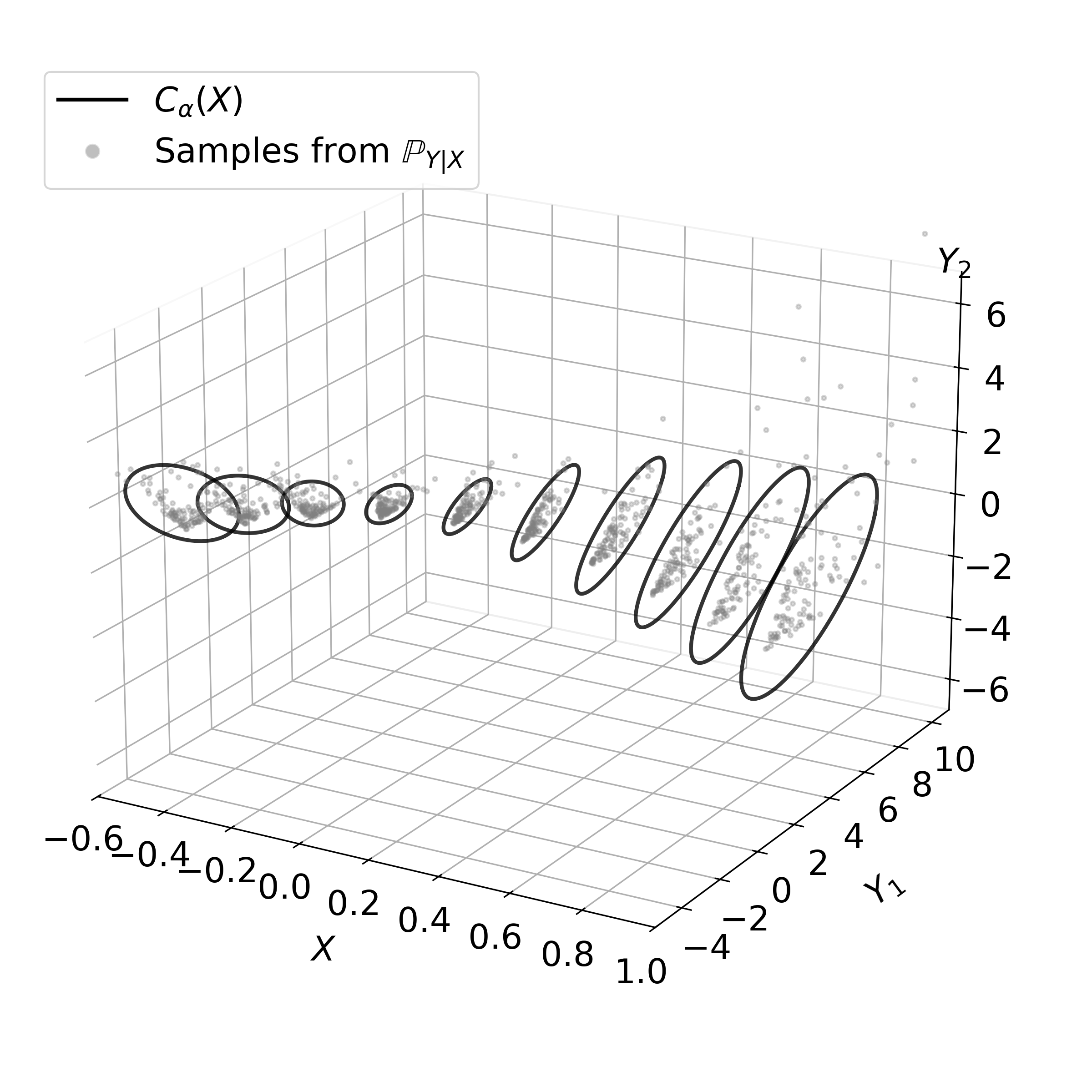
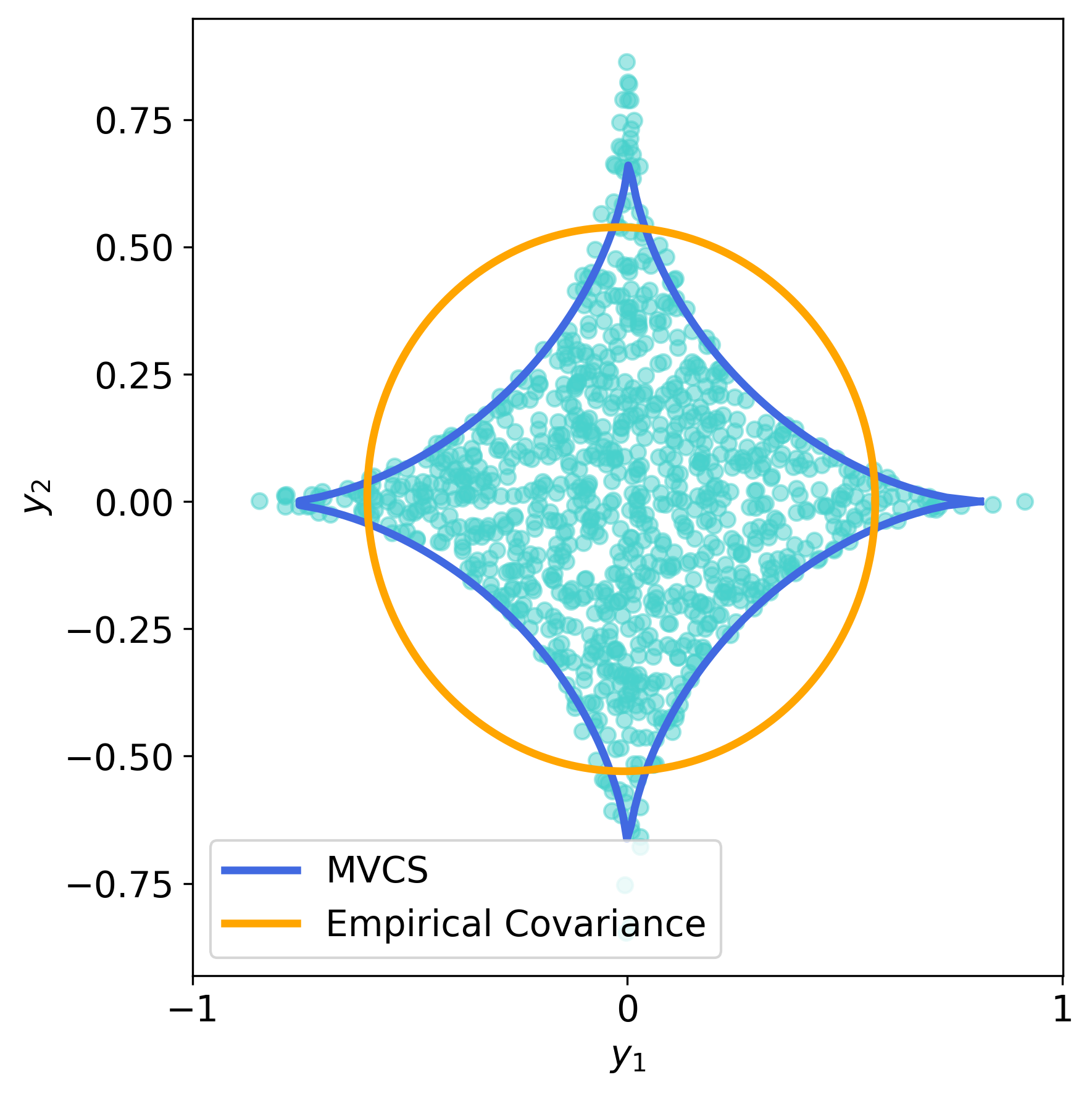
While split conformal prediction guarantees marginal coverage, approaching the stronger property of conditional coverage is essential for reliable uncertainty quantification. Naive conformal
scores, however, suffer from poor conditional coverage in heteroskedastic settings. In univariate
regression, this is commonly addressed by normalizing nonconformity scores using estimated local
score variance. In this work, we propose a natural extension of this normalization to the multivariate setting, effectively whitening the residuals to decouple output correlations and standardize
local variance. We demonstrate that using the Mahalanobis distance induced by a learned local
covariance as a nonconformity score provides a closed-form, computationally efficient mechanism for
capturing inter-output correlations and heteroskedasticity, avoiding the expensive sampling required
by previous methods based on cumulative distribution functions. This structure unlocks several
practical extensions, including the handling of missing output values, the refinement of conformal
sets when partial information is revealed, and the construction of valid conformal sets for transformations of the output. Finally, we provide extensive empirical evidence on both synthetic and
real-world datasets showing that our approach yields conformal sets that significantly improve upon
the conditional coverage of existing multivariate baselines.